
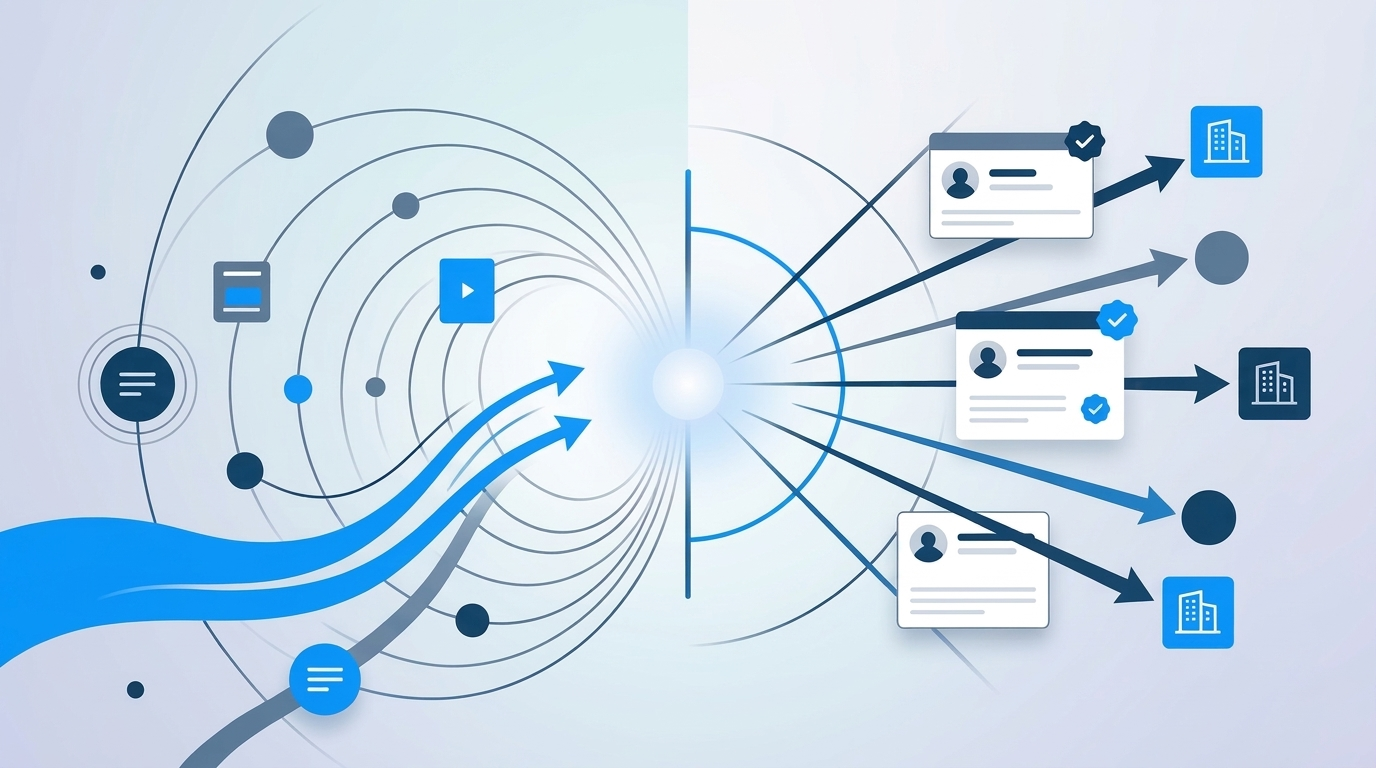
Businesses use a variety of sales and marketing strategies to attract prospective clients, generate qualified pipeline, and accelerate revenue. Two of the most foundational methodologies across modern commerce are inbound and outbound campaigns.
Although both approaches share the ultimate objective of generating revenue opportunities, they operate through fundamentally opposing mechanics. Inbound campaigns focus on attracting prospects through valuable content, organic search visibility, and educational resources. Outbound campaigns proactively initiate targeted communication with specific decision-makers through channels like cold email, LinkedIn outreach, and direct sales calling.
Understanding the operational mechanics, economic trade-offs, and strategic advantages of each approach enables revenue leaders to choose the right strategy for their target market, sales cycle length, and available resources.
In this comprehensive guide, we examine what inbound and outbound campaigns are, evaluate their key differences across ten critical dimensions, walk through real-world B2B scenarios, and show how high-growth businesses integrate both into a unified customer acquisition engine.
What Are Inbound Campaigns?
An inbound campaign is a marketing strategy engineered to attract prospective buyers by publishing educational resources, providing actionable insights, and solving problems prospects are already actively researching.
Rather than reaching out uninvited, businesses build high-visibility touchpoints where potential customers naturally discover their expertise during their independent buying journey.
Consider a company offering specialized CRM management and data cleaning services. It publishes in-depth research articles on database hygiene, contact enrichment, and duplicate suppression. A sales operations director searching for solutions to high email bounce rates discovers one of these guides. Impressed by the technical authority, the visitor explores the company's offerings, downloads a checklist, or submits an inquiry for a database audit. That entire journey exemplifies an inbound campaign.
Common Inbound Marketing Channels
Modern B2B organizations leverage several core inbound channels to attract and nurture qualified prospects:
- Search Engine Optimization (SEO): Optimizing website architecture and authoritative content to rank high in organic search results for commercial and informational queries.
- Content Marketing: Publishing research reports, whitepapers, comprehensive blog guides, teardowns, and customer case studies that demonstrate domain expertise.
- Organic Social Media: Sharing thought leadership, market commentary, and tactical breakdowns on platforms like LinkedIn to build professional authority and organic followership.
- Webinars and Virtual Workshops: Hosting live educational sessions and product demonstrations addressing complex industry challenges.
- Email Newsletters & Nurture Sequences: Providing ongoing value and strategic updates to opt-in subscribers to maintain top-of-mind brand recall over extended sales cycles.
The Strategic Advantage of Inbound Intent
Inbound leads carry high baseline intent because the prospect initiated the interaction to solve an existing problem. However, inbound pipelines require significant patience to build, and you cannot control which specific companies or job titles land on your website.
What Are Outbound Campaigns?
An outbound campaign is a proactive sales and marketing strategy where a business directly identifies, contacts, and engages specific ideal prospects rather than waiting for them to discover its brand.
The business establishes granular Ideal Customer Profile (ICP) criteria—such as industry sector, headcount range, technology stack, geographic footprint, and executive job titles—researches target accounts, and initiates direct, personalized conversations.
Imagine a B2B SaaS platform that automates email verification. Instead of waiting for marketing agencies and lead generation firms to stumble across its landing page, its revenue team researches agencies managing high-volume email workflows, identifies founders and operations directors, verifies their direct email addresses, and delivers highly relevant, customized proposals. That is the essence of an outbound campaign.
Common Outbound Marketing Channels
Outbound revenue teams deploy targeted, multi-channel cadences across several primary execution channels:
- Cold Email Campaigns: Reaching verified business executives with personalized, value-oriented messaging tailored to their specific company initiatives and pain points.
- LinkedIn Outreach: Connecting directly with decision-makers, engaging with their industry commentary, and initiating exploratory business conversations.
- Cold Calling & Direct Dials: Contacting verified decision-makers via telephone to qualify interest, uncover immediate requirements, and schedule discovery meetings.
- Account-Based Advertising (ABM Ads): Running hyper-targeted paid campaigns on platforms like LinkedIn Ads directed exclusively at pre-selected target accounts and buying committees.
- Direct Sales Outreach & Executive Introductions: Crafting bespoke proposals, video teardowns, and executive briefings for high-value enterprise accounts.
The Foundation of Outbound Success
Outbound campaigns give you total control over who enters your pipeline. However, outbound effectiveness is entirely dependent on data hygiene. As highlighted in our research on B2B data decay, stale contact records and unverified emails burn domain reputation and sabotage sales productivity.
Inbound vs. Outbound Campaigns: Key Differences
While both approaches share the ultimate goal of driving pipeline and closed-won revenue, their strategic assumptions, operational execution, and resource requirements differ significantly across every stage of the funnel.
Audience Control vs. Buyer Intent
The defining contrast between inbound and outbound lies in the relationship between audience control and buyer intent. Inbound campaigns deliver leads with high inherent intent—they came looking for you. However, you have minimal control over company size, budget, or authority of who fills out the form.
Outbound flips this dynamic completely: you select the exact company, revenue tier, and executive role with surgical precision. The challenge is that the prospect was not actively searching for you at that exact minute, requiring your messaging to instantly articulate relevant commercial value.
Time Horizon and Feedback Loops
Inbound marketing is an equity-building investment. High-ranking SEO content and authoritative guides can generate inbound leads for years with minimal marginal cost, but ranking organically takes months of consistent effort.
Outbound provides immediate market validation. When you launch a targeted outreach sequence to 200 verified decision-makers, you receive tangible feedback on your value proposition, objection patterns, and pricing within days.
| Dimension | Inbound Campaigns | Outbound Campaigns |
|---|---|---|
| Strategic Approach | Pull mechanism: Attracts buyers by offering value and solutions | Push mechanism: Proactively initiates contact with selected accounts |
| Audience Selection | Audience self-selects by discovering your content and brand | Business selects exact accounts matching its granular ICP |
| First Touchpoint | Prospect initiates interest by visiting, downloading, or inquiring | Business initiates communication via email, phone, or LinkedIn |
| Primary Channels | SEO, content marketing, webinars, organic social, newsletters | Cold email, direct dials, LinkedIn outreach, account-based ads |
| Targeting Logic | Driven by search keyword intent and public topic interest | Driven by firmographics, technographics, and verified buying titles |
| Speed to Pipeline | Compounds gradually; typically requires 3 to 9 months of momentum | Immediate; campaigns can generate qualified meetings within weeks |
| Upfront Resource Needs | Heavy creative investment in content, technical SEO, and domain authority | Investment in prospect research, list building, and email verification |
| Scalability Model | High leverage: one published asset can attract thousands indefinitely | Linear leverage: outreach volume scales with data and SDR capacity |
| Personalization Level | Segmented: designed for broader buyer personas and topic cohorts | Hyper-personalized: tailored to specific companies and individual roles |
| Relationship Dynamic | Built over time through repeated educational content engagement | Built through direct, focused one-on-one business dialogue |
Real-World Scenarios: How a B2B Company Deploys Both
To understand how these strategies function in practice, let's examine how a B2B software company offering high-volume email verification technology would deploy an inbound vs. an outbound campaign.
Scenario A: The Inbound Campaign Workflow
The company's marketing team sets out to capture organic demand from sales teams and agencies struggling with deliverability issues:
1. Keyword Research: Identifies high-intent queries like 'how to verify catch-all emails', 'prevent cold email bounces', and 'B2B list cleaning best practices'.
2. Authoritative Content: Publishes in-depth technical guides explaining SMTP handshake mechanics, accept-all mailboxes, and spam trap risks.
3. Lead Magnets: Offers a free interactive tool that analyzes domain DNS records and delivers a preliminary deliverability audit.
4. Organic Conversion: Readers seeking deeper database validation sign up for a free credit trial or book an onboarding consultation.
Result: The company establishes ongoing organic authority, capturing inbound buyers at the exact moment they experience deliverability panic.
Scenario B: The Outbound Campaign Workflow
Simultaneously, the revenue team wants to acquire 50 fast-growing digital marketing agencies that send millions of outbound emails every month:
1. Granular ICP Definition: Filters for US and European agencies with 15–100 employees offering cold outbound and lead generation services.
2. Decision-Maker Research: Identifies founders, Heads of Outbound, and Operations Directors responsible for agency tech budgets.
3. Multi-Tier Verification: Enriches and verifies direct work emails, eliminating invalid mailboxes and risky servers.
4. Highly Relevant Outreach: Sends concise, personalized emails demonstrating how reducing accept-all bounce rates protects client sender domains while reducing verification costs.
5. Follow-Up Cadence: Engages interested agency owners via LinkedIn and delivers custom volume pricing.
Result: Within three weeks, the outbound campaign books 18 executive demos with qualified enterprise agencies that had never heard of the software before.
Advantages and Disadvantages of Inbound Campaigns
Inbound marketing is an exceptional engine for sustainable brand equity, but it carries distinct operational limitations that revenue teams must account for.
- Compounding long-term ROI: Unlike paid channels where traffic stops when ad spend ceases, organic content continues driving inbound pipeline indefinitely.
- Pre-qualified buyer trust: Prospects who consume multiple case studies, blogs, and guides enter discovery calls already viewing your company as a trusted authority.
- Shorter closing cycles for warm leads: Because inbound prospects initiate contact during active evaluation, they frequently close faster once qualified.
- Extended lead time: Building search rankings and brand presence typically requires 6 to 12 months of steady publishing and technical optimization.
- Unpredictable lead quality: A viral blog post may attract thousands of students, junior staff, or consumers who lack purchasing authority or budget.
- Fierce competitive saturation: Ranking for high-value commercial keywords often means competing against established enterprise platforms with massive backlink moats.
Advantages and Disadvantages of Outbound Campaigns
Outbound sales prospecting provides unmatched agility and targeting precision, but requires rigorous execution, data hygiene, and operational discipline.
- Laser-focused account targeting: You determine exactly which enterprise logos, verticals, and buying committees enter your sales pipeline.
- Rapid speed to execution: Outbound campaigns can be conceptualized, researched, verified, and launched within days, generating immediate sales feedback.
- Direct access to C-suite decision-makers: Reaches senior buyers who rarely browse search engines or read marketing blogs for software recommendations.
- Flexible market testing: Enables revenue teams to test messaging, pricing models, and new verticals with small, controlled cohorts before committing broad marketing budgets.
- Absolute dependency on data accuracy: Outdated contact records, stale titles, and unverified emails result in high bounce rates, burned domains, and wasted SDR hours.
- Diminishing returns on generic messaging: In an era of automated spam, low-effort template blasts generate near-zero replies and damage brand reputation.
The Hybrid Growth Model: Combining Inbound and Outbound
High-growth B2B organizations do not view inbound and outbound as mutually exclusive alternatives. Instead, they operate an integrated 'All-Bound' acquisition model where each strategy reinforces the other.
When an outbound sales rep reaches out to a Tier-1 target account, the prospect's first action is almost always to visit the sender's website. If the site features comprehensive research, technical guides, client case studies, and transparent founder profiles, the cold outreach gains instant credibility.
Conversely, inbound marketing generates invaluable account-level intelligence. When website analytics or IP reveal that an enterprise account matching your ICP has visited pricing or read multiple articles, your outbound team can initiate timely, hyper-relevant outreach to key decision-makers at that account.
The All-Bound Growth Multiplier
Combining inbound credibility with outbound agility creates a powerful flywheel: inbound content warms up target accounts, while outbound sales captures high-value deals that would never have converted on their own.
How to Build an Integrated Inbound + Outbound Pipeline
To build a resilient revenue pipeline that balances short-term sales velocity with long-term organic authority, businesses should execute an integrated six-stage acquisition framework:
Define Granular ICP
Establish crystal-clear account criteria: industry verticals, revenue bands, headcount, technographic signals, and target titles.
Build Inbound Authority
Publish high-value research, technical teardowns, and SEO guides answering the toughest questions your target buyers ask.
Research Target Accounts
Assemble human-qualified prospect lists matching your ICP, mapping buying committees and operational decision-makers.
Verify & Enrich Contact Data
Eliminate stale records, append direct phone lines, and run multi-layer email verification to protect sender deliverability.
Launch Multi-Touch Outreach
Deploy personalized cold email and LinkedIn cadences that reference relevant industry pain points and authoritative content.
Measure Full-Funnel Yield
Track organic conversion velocity alongside outbound meeting rates, continually refining messaging and targeting based on data.
Verify Business Email Addresses Before Launch
Before any prospect list is loaded into an outbound sequencer, every business email address must undergo rigorous technical verification. Eliminating hard bounces, invalid mailboxes, and disposable domains keeps bounce rates strictly under 2% and preserves corporate domain deliverability.
How GYP Powers Outbound Prospecting Engines
Running a predictable outbound engine requires far more than simply exporting generic names from a software database. Modern revenue teams need verified decision-makers, human-validated company criteria, and enriched CRM intelligence.
Get Your Prospect (GYP) provides bespoke B2B research and data solutions that empower sales teams to execute high-confidence outbound campaigns:
- B2B Contact List Building: Hand-researched, human-qualified contact lists tailored specifically to your custom ICP parameters and geographic markets.
- ICP-Based Prospect Research: Filtering target accounts across industry classifications, verified headcount, business models, and operational capabilities.
- Decision-Maker Identification: Navigating matrixed enterprise organizational charts to identify true budget owners and buying champions.
- CRM Data Cleaning: Deduplicating records, updating decayed job titles, and eliminating stale contacts to restore pipeline integrity.
- B2B Data Enrichment: Appending missing executive emails, verified direct dials, and fresh firmographic intelligence to existing CRM records.
- Account-Based Marketing (ABM) Research: Building bespoke dossiers on high-priority enterprise accounts to support executive multi-threading.
Frequently Asked Questions
What is the main difference between inbound and outbound campaigns?
The fundamental difference is who initiates the interaction. Inbound campaigns attract potential buyers through valuable content, search rankings, and social media so prospects discover you on their own. Outbound campaigns proactively identify and contact specific target accounts and decision-makers through direct outreach such as cold email, phone calls, and LinkedIn messaging.
Which strategy delivers better ROI: inbound or outbound?
Neither strategy is universally superior—their ROI depends on your business model, deal size, and sales cycle. Inbound delivers high compounding long-term ROI once organic rankings and brand authority are established. Outbound provides immediate, predictable pipeline generation and is particularly effective for high-ACV enterprise services where deal values justify targeted research.
Is cold emailing an inbound or outbound strategy?
Cold emailing is strictly an outbound strategy. The business proactively identifies target prospects who have not previously requested information, initiates contact, and introduces relevant solutions tailored to their company's needs.
Is SEO considered an inbound marketing channel?
Yes. Search Engine Optimization is a cornerstone of inbound marketing because it positions your website and educational resources in front of users who are actively searching for solutions, questions, or vendors.
Can early-stage startups and small businesses use both strategies?
Yes. In fact, early-stage businesses often rely heavily on outbound campaigns to secure their initial customers and validate product-market fit quickly, while simultaneously publishing core foundational content and SEO pages that will compound into sustainable inbound traffic over time.
What information is required to launch a successful B2B outbound campaign?
A high-performing outbound campaign requires a clearly defined Ideal Customer Profile (ICP), accurate target account research, verified decision-maker contact details (direct email and phone), compelling personalized messaging addressing specific pain points, and a structured follow-up cadence.
How does data decay impact outbound campaigns compared to inbound?
Data decay severely cripples outbound campaigns because outdated email addresses trigger hard bounces, damage sender domain reputation, and waste sales rep time. While inbound forms capture real-time contact details directly from the user, outbound databases naturally decay by 12% to 25% annually, making regular database cleaning and pre-send verification essential.
Related Resources & Specialized Services
Explore our research and enterprise data solutions to build high-converting customer acquisition pipelines:
Compare the strengths and limitations of automated prospecting versus human investigative research in modern B2B sales.
Discover why B2B databases degrade over time and how continuous CRM data hygiene safeguards outbound campaign deliverability.
Custom-researched, human-qualified B2B prospect lists tailored specifically to your exact Ideal Customer Profile and buying committee.
Append verified decision-makers, direct-dial phone numbers, and rich firmographic data to incomplete contact records.
Deduplicate, validate, and standardize contact databases to eliminate wasted sales effort and protect domain health.
Final takeaway
Inbound and outbound campaigns are not competing philosophies—they are two halves of an effective modern revenue engine. Inbound marketing builds enduring brand equity, attracts high-intent problem solvers, and establishes market authority. Outbound prospecting provides precision targeting, rapid revenue velocity, and direct access to dream accounts. By aligning both strategies under a cohesive data-driven framework, B2B organizations achieve predictable, sustainable growth across every market condition.