
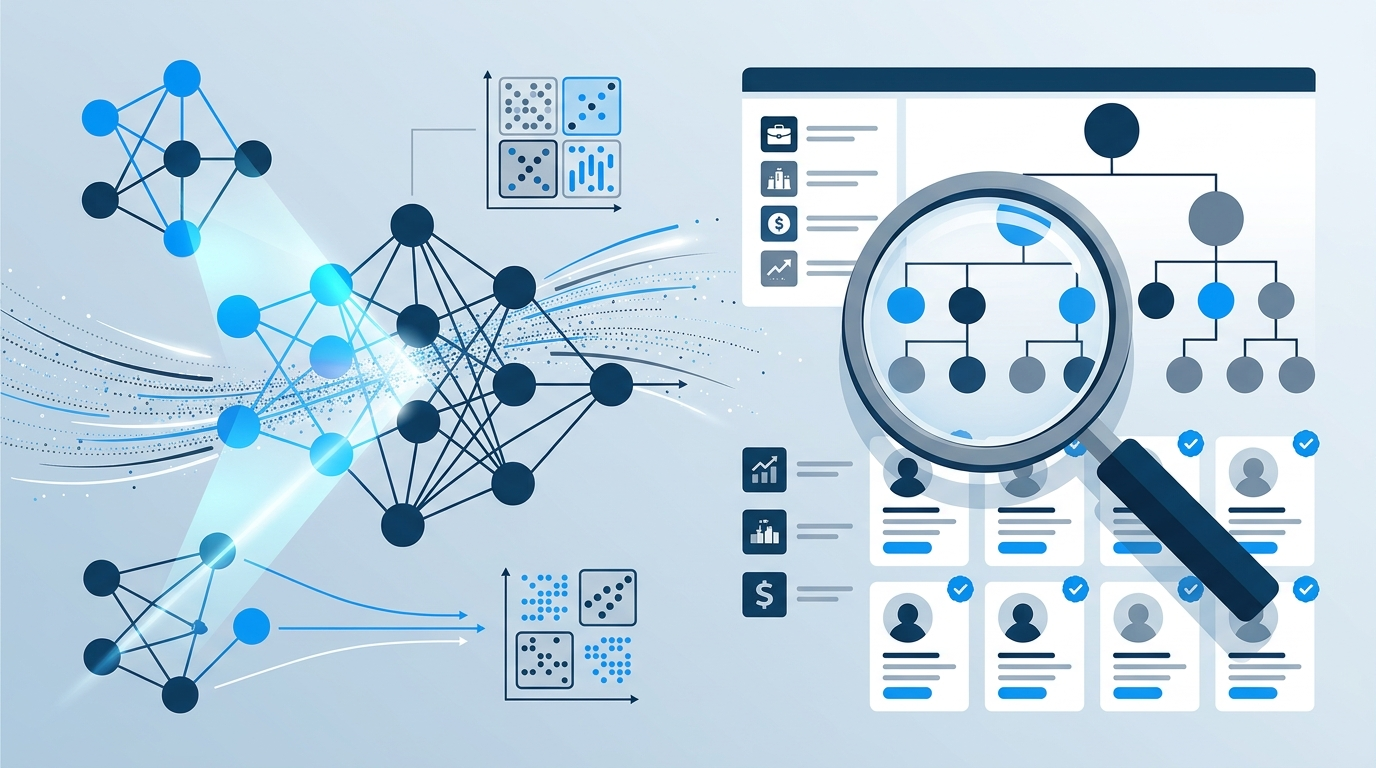
The surge of AI agents, automated web scrapers, and large language models has ignited a passionate debate across B2B sales: will algorithmic prospecting render human research obsolete, or does unchecked automation simply flood sales pipelines with low-converting, hallucinated leads?
Many industry commentators frame this as a black-and-white battle: either manual research is painfully slow and outdated, or AI tools are inaccurate and dangerous. Both perspectives miss the commercial reality of modern revenue operations.
AI excels at large-scale data ingestion, pattern recognition, and accelerating administrative overhead. Human researchers, by contrast, excel at interpreting organizational nuance, verifying true buying authority, untangling complex ICP criteria, and conducting deep contextual qualification.
The question is not whether AI will replace human researchers, but where each performs best—and how forward-thinking sales teams combine algorithmic speed with human discernment to build high-converting, outreach-ready databases.
What Is AI-Powered B2B Lead Generation?
AI-powered lead generation uses machine learning algorithms, natural language processing (NLP), and multi-source scrapers to discover, extract, and categorize business prospects at massive scale.
Rather than manually inspecting company directories and websites one by one, AI platforms crawl public web pages, corporate registries, job boards, and social platforms in seconds, compiling thousands of prospective accounts and contact records based on predefined filters.
Modern AI prospecting tools go beyond basic keyword searching. They analyze intent signals, cluster companies by technographic footprint, score accounts based on historical win rates, and draft personalized outbound snippets tailored to a prospect's public bio.
- Rapid market scanning: Analyzing tens of thousands of company domains and public filings in minutes.
- Firmographic classification: Segmenting organizations by declared industry, reported employee counts, and geographic headquarters.
- Intent and signal detection: Tracking public triggers like funding announcements, open job requisitions, and software stack changes.
- Automated lead scoring: Ranking accounts statistically against historical closed-won patterns in your CRM.
- First-draft personalization: Synthesizing public prospect details into introductory email icebreakers.
The Core Nature of AI Prospecting
AI-powered tools are extraordinary at processing existing information and identifying statistical patterns, but they do not independently verify physical reality. If an underlying public source is outdated, ambiguous, or misleading, an AI model will ingest and amplify that error with high linguistic confidence.
What Is Human-Led B2B Prospect Research?
Human-led prospect research is the investigative, context-driven process where skilled researchers identify, qualify, and verify potential buyers against specific commercial criteria.
Unlike automated tools that evaluate companies solely through surface-level keywords, human researchers examine how a business actually operates: its true revenue model, product offerings, operational structure, and decision-making hierarchy.
In complex B2B markets, titles rarely tell the whole story. A human researcher investigates whether a 'VP of Operations' at a mid-market manufacturer actually controls software procurement or if that purchasing power belongs to a newly hired Director of Digital Transformation.
- Nuanced ICP qualification: Discerning whether a target business truly fits your offering or merely mentions related keywords on its blog.
- Organizational chart mapping: Identifying buying committees, technical evaluators, and executive sponsors across matrixed teams.
- Contextual cross-verification: Comparing press releases, SEC filings, professional profiles, and company leadership pages to validate employment.
- Niche industry expertise: Navigating specialized sectors like industrial fabrication, regulatory compliance, or healthcare tech where terminology is intricate.
- Human accountability: Reviewing every data field with commercial discernment before a contact record enters an outbound campaign.
AI vs. Human Research: Direct Comparison
To understand how to allocate your sales development resources, it helps to compare AI and human research across the core dimensions that directly impact outbound performance, data quality, and customer acquisition cost.
Speed and Scalability: The Volume Advantage
AI has fundamentally redefined research velocity. A human researcher manually checking company websites and building contact lists might thoroughly research 40 to 60 high-quality leads in a day. An AI-powered system can process thousands of candidate profiles in the same timeframe.
For broad horizontal campaigns where total addressable market (TAM) is vast and deal values are modest, algorithmic speed allows revenue teams to uncover emerging accounts that manual teams might never reach in time.
Data Accuracy and Verification: The Truth Gap
Speed without verification is counterproductive. When an automated scraper indexes a web page, it accepts text at face value. If an executive left the company three months ago but their bio remains on an unmanaged team page, the AI extracts that contact as current.
Human research acts as a critical reality check. By cross-referencing active social activity, recent company press releases, and verified email responses, human researchers filter out phantom decision-makers and safeguard your domain reputation.
Decision-Maker Identification Beyond Job Titles
Automated scrapers rely strictly on keyword matching within job titles. This creates severe false-positive and false-negative rates in modern B2B organizations.
For instance, a search for 'VP of Sales' might surface a regional franchise manager who has zero software purchasing power, while missing a 'Head of Commercial Excellence' who holds the exact budget you need. Human researchers look past vanity titles to understand actual operational scope.
Handling Niche Industries and Complex Business Models
Consider a client who targets companies that manufacture precision CNC components for aerospace applications. An AI scraper will flag suppliers, distributors, equipment repair shops, and aerospace consulting firms simply because the terms 'aerospace' and 'CNC' appear across their digital footprint.
A human researcher visits the company's product catalog, examines certifications (like AS9100), and confirms whether the firm actually produces hardware in-house. That distinction prevents sales reps from wasting dozens of hours pitching the wrong profile.
| Prospecting Dimension | AI-Powered Research | Human-Led Research | The Optimal Hybrid Role |
|---|---|---|---|
| Research Speed & Scale | Scans thousands of domains and records in minutes | Deliberate, in-depth investigation per account | AI identifies broad candidate pool; humans qualify shortlist |
| ICP & Industry Nuance | Keyword matching; prone to false positives | Deep contextual grasp of actual business models | Humans define precision criteria; AI executes discovery |
| Decision-Maker Accuracy | Scrapes titles; misses internal authority structures | Uncovers true purchasing power and committee roles | AI extracts roster candidates; humans verify decision rights |
| Niche & Complex Verticals | Struggles with non-standard taxonomy and jargon | Quickly grasps specialized, custom requirements | Human researchers guide methodology and custom taxonomy |
| Data Integrity & Freshness | Vulnerable to cached directories and hallucinations | Multi-source cross-checking guarantees high accuracy | Human QA eliminates false data before sequence launch |
| Cost & Resource Efficiency | Low cost per raw lead; high waste downstream | Higher upfront research cost; higher conversion yield | Maximized ROI: automated scale combined with human precision |
What the 2026 Research Shows: Empirical Evidence
Recent enterprise studies confirm that while sales organizations are aggressively adopting AI tools, the highest-performing teams are not replacing human researchers—they are rewiring workflows to pair automation with human judgment.
Salesforce's State of Sales (7th Ed, 2026) revealed over half of sales pros actively use AI, with 92% of agent users reporting positive prospecting impact.
Sales organizations project an average 34% drop in prospect research time when deploying AI agents for initial data gathering and admin tasks.
McKinsey's 2026 B2B growth report found market leaders are 4x more likely to deploy deep 1-to-1 personalization and 2x as likely to adopt generative AI.
The European Marketing Academy (EMAC) Finding on Trust
A landmark 2026 academic study published in the European Marketing Academy proceedings examined why revenue teams reject automated lead scoring. The researchers discovered that predictive score accuracy alone does not drive sales adoption: when AI recommendations lack explainability and transparent human verification, sales reps frequently abandon them. Trust in prospect data requires human validation signals.
Where AI Works Best in B2B Lead Generation
To maximize research return on investment, AI should be deployed where sheer data processing volume and speed create substantial operational leverage.
- Broad-spectrum account discovery: Compiling comprehensive initial lists of thousands of companies matching high-level parameters (geography, industry, headcount).
- Automated data hygiene and deduplication: Normalizing disparate company names (e.g. 'IBM Corporation' vs 'IBM Inc.'), standardizing state codes, and flagging duplicate records.
- Public intent signal tracking: Monitoring web signals such as executive job postings, recent patent filings, funding rounds, and technology installations.
- Data clustering and predictive scoring: Segmenting historical customer data to uncover correlations between firmographic attributes and high lifetime value.
- Outbound drafting support: Generating initial draft messaging based on verified account highlights, allowing human reps to refine and personalize with speed.
Where Human Research Outperforms Automation
Human research is indispensable whenever the business context is nuanced, the deal value is substantial, or the cost of a false positive is high.
- Deep ICP qualification: Distinguishing actual business capabilities from marketing buzzwords, third-party distribution, and white-label arrangements.
- Buying committee mapping: Uncovering multi-threaded buying dynamics—especially in enterprise deals where purchases require consensus across finance, IT, and legal.
- Cross-referencing contradictory sources: Resolving conflicting information across LinkedIn profiles, corporate directories, and state business filings.
- High-stakes Account-Based Marketing (ABM): Developing rich, bespoke account profiles for high-value targets where generic outreach would burn the bridge.
- Bespoke data fields: Researching non-standard data attributes that no software API tracks (such as specific ERP installations, fleet sizes, or proprietary compliance badges).
The Hidden Pitfalls of 100% Automated Prospecting
Relying exclusively on automated scraping tools without human intervention creates serious operational bottlenecks that drain revenue and damage brand reputation.
The primary danger is the hallucination of relevance. Automated tools present scraped data with clean formatting, giving revenue leaders a false sense of security. Beneath the surface, unverified automated lists often carry systemic defects:
- The keyword false-positive trap: A company that writes a blog post about 'cloud migrations' gets categorized as a cloud consultancy, wasting reps' time.
- Accelerated data decay: Automated scrapers frequently harvest cached web pages and stale directories. As documented in our research on B2B data decay, business databases experience 12% to 25% role turnover every 12 to 24 months.
- Severe sender reputation damage: Blasting automated emails to invalid or unverified catch-all mailboxes drives bounce rates past 8–10%, landing your corporate domain on global spam blocklists.
- Sales rep cynicism and fatigue: When reps spend their days reaching out to defunct companies, wrong contacts, and irrelevant titles, pipeline momentum collapses.
The Modern Hybrid Workflow: Combining AI Speed with Human Precision
The most effective prospecting engines don't force a compromise between volume and accuracy. They structure lead generation as an integrated hybrid pipeline: AI accelerates data discovery, while human researchers provide qualitative analysis and verification.
Here is how a high-performing hybrid B2B prospect research workflow operates from initial ICP definition to final campaign delivery:
ICP & Criteria Definition
Define granular qualification parameters: industries, revenue bands, tech stack, regional footprint, and exact buying roles.
AI-Assisted Account Discovery
Deploy algorithmic scrapers and database aggregators to rapidly assemble a broad candidate pool of candidate companies.
Human Contextual Qualification
Experienced researchers inspect company websites, offerings, and business models to eliminate false positives.
Decision-Maker Org Mapping
Identify exact executives with budget control, cross-referencing organizational structure beyond superficial job titles.
Multi-Stage Verification
Validate contact coordinates, direct dials, and business email mailboxes to ensure complete deliverability.
CRM-Ready Pipeline Delivery
Deliver deduplicated, standardized, and fully qualified prospect records ready for high-confidence outbound execution.
Verify Business Email Addresses
Before any prospect list is loaded into a sequencer or CRM, every single email address must undergo multi-tier technical validation to eliminate invalid mailboxes, spam traps, and toxic server configurations.
Catch-all and accept-all mailboxes represent a particularly dangerous category: automated tools often categorize them as valid, but unverified delivery can cause silent bounces and domain penalization.
Strategic Decision Matrix: When to Lean on Each Approach
Not every campaign warrants identical research depth. Modern revenue operations allocate AI and human resources based on Average Contract Value (ACV), market concentration, and outbound risk.
| Campaign Strategy | Target Market & Deal Size | Recommended Approach | Operational Rationale |
|---|---|---|---|
| High-Volume SMB Outbound | Broad horizontal markets (ACV < $5k) | AI-Heavy + Automated Verification | Low deal value requires aggressive volume; minor false-positive rates are commercially acceptable |
| Mid-Market Outbound | Specialized B2B verticals (ACV $20k–$75k) | Balanced Hybrid (AI Discovery + Human QA) | Requires accurate role confirmation to maintain sales velocity and prevent rep burnout |
| Enterprise Account-Based Marketing | Tier-1 target accounts (ACV $100k+) | Human-Led Research & Committee Mapping | High deal stakes make false positives and generic outreach catastrophic to the pipeline |
| Highly Regulated or Niche Sectors | Defense, aerospace, medtech, industrial | Bespoke Human-Led Investigation | Public records are sparse or proprietary; automated scrapers lack technical discernment |
Frequently Asked Questions
Is AI better than human research for B2B lead generation?
Neither approach is universally superior. AI is dramatically faster at processing vast data quantities, detecting web signals, and normalizing records. Human research is far more reliable for evaluating nuanced ICP fit, identifying true decision-making power, and verifying ambiguous data. The most effective prospecting operations use AI to accelerate research and humans to guarantee accuracy.
Can AI accurately identify B2B decision-makers?
AI can identify individuals whose stated job titles match your search keywords, but it often struggles to determine actual buying authority. In modern organizations, purchasing power is frequently distributed across committees or held by leaders with non-standard titles. Human researchers excel at mapping organizational hierarchies and identifying the real stakeholders behind buying decisions.
What are the biggest risks of using 100% automated prospect lists?
The greatest risks include high email bounce rates that damage your domain reputation, misaligned messaging sent to irrelevant contacts, and wasted sales rep time chasing false-positive leads. Furthermore, automated tools frequently scrape cached directories that contain outdated employment data.
Why is manual prospect research still relevant in the age of AI?
Manual research provides contextual intelligence that algorithms cannot duplicate. A human researcher can verify whether a company actually manufactures a product or merely resells it, cross-check executive moves across multiple sources, and ensure that every prospect strictly matches your target criteria before your team reaches out.
How does the hybrid model reduce customer acquisition cost (CAC)?
The hybrid model reduces CAC by lowering the cost per qualified opportunity. While AI minimizes the hours spent searching for accounts, human qualification ensures your sales team only focuses on real buyers. This increases conversion rates, eliminates wasted outbound activity, and protects email deliverability.
How should a sales team transition to a hybrid research workflow?
Start by auditing your current pipeline: identify where reps spend the most non-selling time. Deploy AI tools to handle broad account discovery and database hygiene, while reserving human researchers—either in-house or through a specialized partner like Get Your Prospect—for account qualification, org mapping, and final data verification.
Related Resources & Recommended Services
Explore our research and specialized data solutions to build high-accuracy prospecting pipelines:
Understand the five types of contact decay and discover actionable strategies to audit and refresh your CRM data.
Custom-researched, human-qualified B2B prospect lists tailored specifically to your exact Ideal Customer Profile and buying committee.
Append verified decision-makers, direct-dial phone numbers, and rich firmographic data to incomplete contact records.
Deduplicate, validate, and standardize contact databases to eliminate wasted sales effort and protect domain health.
Final takeaway
B2B lead generation is undergoing a fundamental transformation. AI has eliminated the excuse for slow, manual data collection—but it has also lowered the barrier to flooding inboxes with generic, unverified noise. As buyers become more selective, competitive advantage will not belong to the teams who generate the most raw leads. It will belong to the revenue organizations that pair algorithmic research speed with human analytical rigor, ensuring every outreach conversation starts with accurate, relevant, and verified prospect intelligence.