
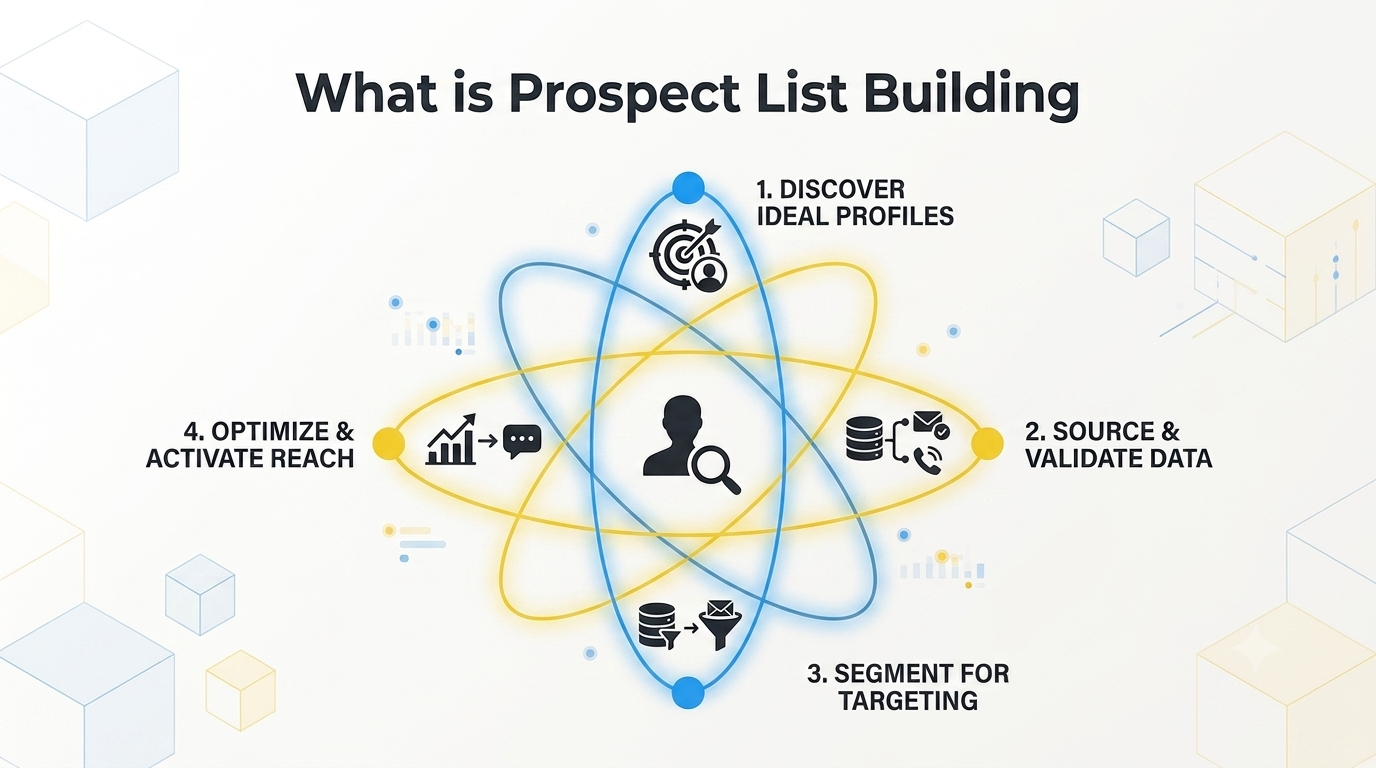
Prospect list building is one of the most important parts of B2B sales and marketing. Before a campaign can perform well, a business needs to know who it should target, why those prospects matter, and how to organize them for outreach.
A good prospect list is not just a spreadsheet full of names. It is a filtered, structured, and qualified list of people or companies that match your ideal customer profile. When done well, list building helps sales teams save time, improve targeting, and focus on accounts that are more likely to convert.
That is why prospect list building matters so much. Without it, even strong outreach becomes random, inefficient, and easy to ignore.
What Is Prospect List Building?
Prospect list building is the process of identifying, collecting, and organizing potential customers who are a good fit for your product or service.
The goal is to build a list of prospects that your sales or marketing team can use for outreach, lead nurturing, and pipeline generation.
The exact data fields may vary depending on the business, but the idea is always the same: build a list that is accurate, relevant, and usable.
- Full name & contact details
- Job title & decision-making role
- Company name & domain/website
- Industry & market sector
- Company size & headcount range
- Location & geographic region
Why Prospect List Building Matters
Prospect list building matters because it sets the foundation for everything that comes after it.
If the list is weak, the results will be weak. If the list is strong, the rest of the sales process becomes much easier.
- Better targeting: A well-built list helps you focus on prospects that actually fit your offer.
- Higher conversion potential: When prospects match your ideal customer profile, they are more likely to respond and convert.
- Less wasted effort: Sales teams spend less time chasing bad-fit leads or irrelevant contacts.
- Stronger campaign performance: Accurate lists improve email outreach, lead generation, and account-based marketing.
- Cleaner CRM data: Good list building helps keep your database organized and useful.
What Makes a Good Prospect List?
Not every prospect list is worth using. A strong list is built with quality in mind, not just volume.
The most important things in prospect list building are:
- Relevance: The prospects should match your ideal customer profile.
- Accuracy: The data should be correct and up to date, avoiding wrong names or invalid emails.
- Completeness: A good list should include enough information to support outreach and segmentation.
- Segmentation: Prospects should be grouped by industry, geography, company size, or seniority.
- Decision-maker quality: The list should include the right decision-makers with buying influence.
- Usability: The list should be formatted and structured for instant sales execution.
The Prospect List Building Process
A proper prospect list building process usually follows a systematic approach to ensure maximum accuracy and campaign readiness:
- Define the ideal customer profile: Identify the type of company or buyer you want to target (industry, revenue, headcount, geography, role).
- Collect prospect data: Find potential leads using databases, research, websites, directories, or internal records.
- Filter the list: Remove irrelevant, duplicate, or low-quality records.
- Enrich the data: Add missing details such as contact information, company size, or domain data.
- Verify accuracy: Check emails, titles, domains, and other fields so the list is reliable.
- Segment and organize: Sort the list into useful categories for outreach or sales follow-up.
- Deliver for execution: Ensure the final list is ready for CRM upload and campaign execution.
Common Mistakes in Prospect List Building
Many teams make the mistake of treating list building like a numbers game. More records do not automatically mean better results.
A bloated list with bad data is just expensive clutter with ambition.
- Building too broad a list
- Ignoring fit and relevance
- Using outdated data
- Not verifying contact details
- Focusing only on quantity
- Mixing clean and messy records together
- Targeting the wrong decision-makers
What Things Matter Most in Prospect List Building?
If you want prospect list building to actually work, these are the key pillars that matter most:
- Ideal customer fit: The prospect should match the audience your business is meant to serve.
- Data quality: Reliable data is the difference between a usable list and a useless one.
- Decision-maker relevance: The people on the list should have influence, responsibility, or buying power.
- Clear segmentation: The list should be easy to split by campaign, industry, or priority.
- Freshness of data: Old records age badly as people change jobs and email addresses change.
- Actionability: A prospect list should help a team move forward without extra cleanup work.
How GYP Supports Prospect List Building
At GYP, prospect list building is supported through clean, structured, and well-organized data that helps businesses focus on the right prospects faster.
GYP helps teams build better prospect lists by improving the quality of the data behind them. The real value of prospect list building is not in collecting names; it is in building a list that the sales team can confidently use.
That is where GYP fits in. GYP helps businesses create stronger prospect lists by delivering the kind of data foundation that makes targeting, segmentation, and outreach more effective.
- Identifying relevant high-value prospects
- Organizing company and contact data effectively
- Improving account segmentation and priority grouping
- Supporting lead qualification and verification
- Helping revenue teams work with highly reliable lists
Prospect List Building vs Random Lead Collection
Prospect list building is not the same as collecting random contacts. A proper prospect list gives your team direction; random lead collection just gives them work.
| Random Lead Collection | Prospect List Building |
|---|---|
| Broad and unfocused | Targeted and strategic |
| Often messy | Structured and clean |
| Based on volume | Based on fit |
| Hard to use | Ready for action |
| Weak targeting | Better campaign alignment |
Why Prospect List Building Helps Sales and Marketing
Prospect list building benefits both sales and marketing teams by creating a shared source of truth across your organization:
- For sales teams: Better lead quality, easier prioritization, faster outreach planning, and more relevant conversations.
- For marketing teams: Better segmentation, more focused campaigns, higher relevance, and stronger account targeting.
FAQs
Here are answers to frequently asked questions about prospect list building:
- What is prospect list building? — Prospect list building is the process of identifying and organizing potential customers for sales or marketing outreach.
- Why is prospect list building important? — It helps businesses target the right people, improve campaign performance, and reduce wasted effort.
- What makes a good prospect list? — A good prospect list is relevant, accurate, complete, segmented, and ready to use.
- How does GYP help with prospect list building? — GYP supports prospect list building by helping businesses work with cleaner, better-organized, and more usable prospect data.
Final takeaway
Prospect list building is one of the most important foundations in B2B growth. It helps businesses focus on the right people, reduce wasted effort, and build campaigns that are actually worth running. GYP helps businesses build stronger prospect lists with cleaner data, better organization, and more reliable targeting support. If you want prospect list building to work well, the data foundation has to be right from the start.